.png)
MENU
The Bible Pathways Method
At the heart of our mission is a commitment to equipping local pastors, youth leaders, and Sunday school teachers across India with the skills to rightly handle and preach the Word of God.
Rather than prescribing what to preach, our training equips leaders to faithfully interpret Scripture for themselves and their communities. By 2029, we aim to equip 30 coaches and 300 indigenous trainers to lead these workshops across India and into neighboring nations. Every session is a launchpad for transformation in churches, families, and communities across South Asia.
The Challenges We Face
Problem No. 1
The Bible was not written directly to us, but it was written for us. Scripture was penned to people who lived long ago in cultures often far different from ours. If we don't first understand what the author was emphasizing to the original readers, we're in danger of misunderstanding God's message to us.
.png)
The Challenges We Face
Problem No. 2
We're tempted to approach the Bible through our own cultural and personal outlook, often reading into passages what simply isn't there. Instead, we need to understand what the author was communicating to specific people in a specific historical setting. Only then can we ask, "What is God saying to us in our time and culture?"

Pathways Modules
The Method Behind the Modules
Our approach centers on inductive Bible study, but we've simplified the process so it's accessible to everyone, regardless of educational background. We teach at an 8th-grade comprehension level, ensuring concepts can be easily understood and translated into various vernacular languages across India's diverse regions.
The foundation is built on a 7-step method that guides participants through three critical phases: observation (what does the text say?), interpretation (what did it mean to the original audience?), and application (what does it mean for us today?). This pathway helps navigate two major obstacles that often block proper Bible understanding: the cultural and historical gap between ancient texts and modern readers, and our tendency to read our own assumptions into Scripture.

Pathways Modules
The Eight-Module Journey
Each module focuses on a different biblical book or literary style, ensuring participants can handle any passage of Scripture they encounter:
-
Module 1: Jonah - Narrative literature and God's heart for the nations
-
Module 2: 2 Timothy - Pastoral letters and leadership principles
-
Module 3: Whole Story - Biblical theology and the grand narrative
-
Module 4: Genesis - Foundational narratives and origins
-
Module 5: Psalms - Hebrew poetry and worship literature
-
Module 6: Mark - Gospel literature and the life of Christ
-
Module 7: Habakkuk - Prophetic literature and dialogue with God
-
Module 8: Colossians - Pauline theology and Christian living

Pathways Modules
Learning in Community
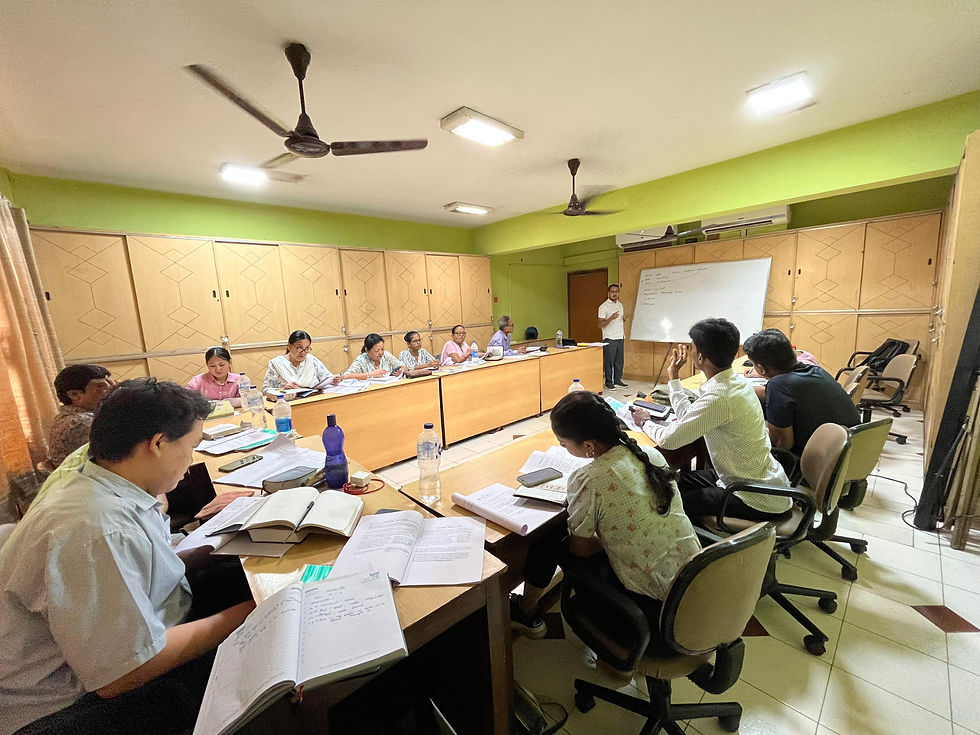
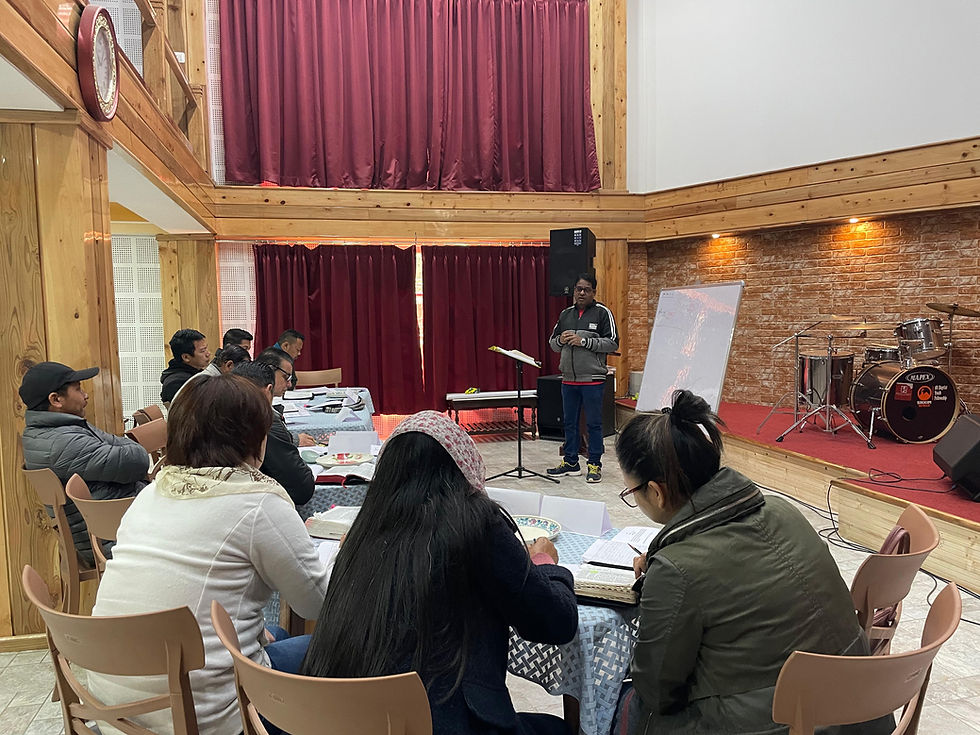
We believe transformation happens best in community. Each module brings together 12-16 participants for 2-3 intensive days of learning. Rather than lecture-heavy sessions, participants spend 70-80% of their time in practical presentation sessions with whiteboards and markers, working through passages together. This collaborative approach ensures everyone learns from one another while the trainer guides group discussions toward clear understanding of God's message.
Pre-assignments prepare participants for each module, and as the series progresses, the learning deepens while maintaining accessibility. The curriculum builds systematically, with each module adding new tools to the participant's biblical interpretation toolkit.
Pathways Modules
Reaching Every Language, Every Region
Our commitment to indigenous ministry means breaking down language barriers. The entire curriculum has been translated into seven major Indian languages—Hindi, Tamil, Telugu, Marathi, Gujarati, Bengali, and Nepali—with more translations planned. This vernacular approach ensures that pastors can not only learn in their heart language but also train others in their local communities using familiar terms and concepts.
What participants receive isn't just head knowledge—it's a reproducible method they can immediately apply in their own study, preaching, and training of others. The tools learned through Bible Pathways equip pastors to faithfully proclaim God's message from any passage of Scripture, building confidence and competence that multiplies throughout their ministry contexts.

Leadership Development
Empowering Local Leadership
Everything we do is designed with sustainability and indigenous ownership in mind. Rather than creating dependency on outside resources or leadership, we intentionally empower regional leaders to take full ownership of the ministry in their areas. This means identifying, training, and continuously developing local trainers who understand their cultural context, speak the local language, and have established credibility within their communities.
Our leadership development goes beyond teaching techniques. We focus on character formation alongside competency building, recognizing that effective ministry flows from leaders who embody the gospel they preach. Regional leaders like Rev Samuel John, Rev Gulab Chaudhari, Pastor Nishith Baria, Pastor Sagar Karkidoli, Rev Lazarus Cornelius, and Mrs Sushma Cornelius exemplify this principle—they're not just skilled trainers but respected spiritual leaders who model what they teach.

Leadership Development
The Ripple Effect
Every leader we train becomes a training center. This multiplication model means that impact grows exponentially rather than arithmetically. A single coach can train multiple trainers, who each train multiple pastors, who each influence multiple congregations, who each reach multiple communities. This ripple effect is already visible in our explosive growth from conducting just a couple of trainings per year to 85 in 2024, with projections exceeding 100 in 2025.
Leadership development isn't a separate program but an integrated component of everything we do. As pastors progress through the Pathways Modules, we're simultaneously identifying and nurturing those with the calling and capacity to become trainers themselves. This creates a natural pipeline from student to teacher, ensuring the movement continues to expand with quality and integrity intact.
